Oil and Gas Is Colorado's Secret Climate Win. Buildings Aren't.
Part 1 of this series focused on the historical trend of emissions from the energy generation and transportation sectors in Colorado. Part 2 covers Oil and Gas, a sector that's quietly doing better than almost anyone gives it credit for, along with Buildings and Agriculture where progress is either getting won in court right now or hasn't really started at all.
Oil and Gas
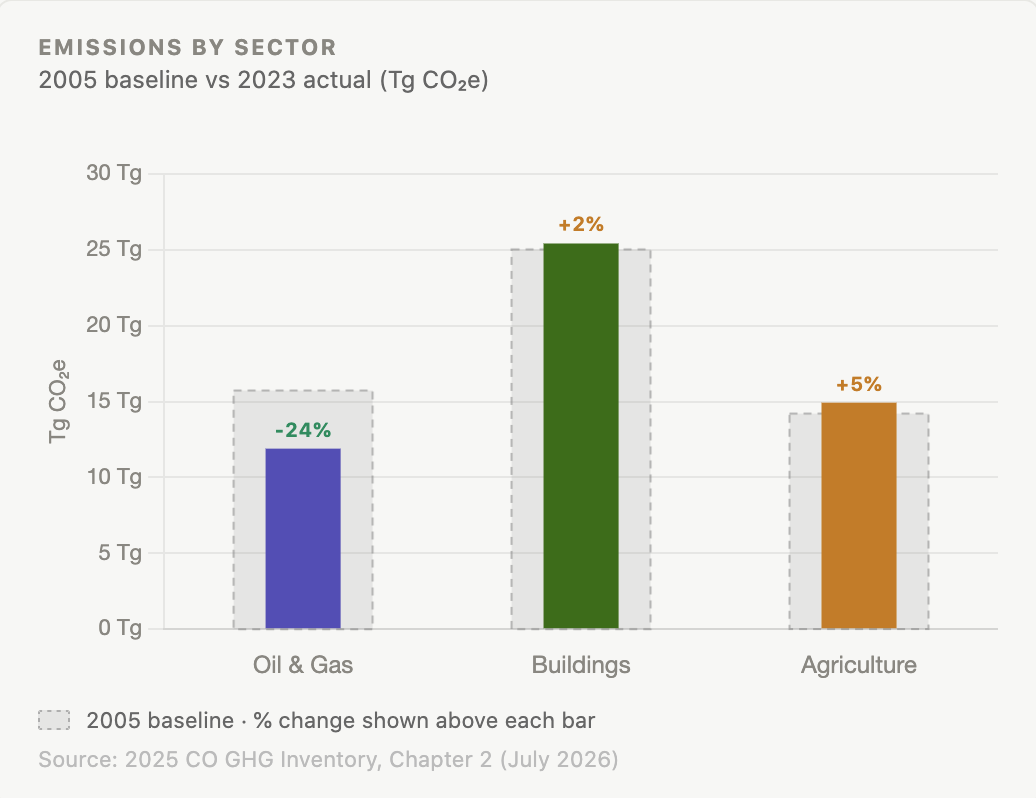
Ask most Coloradans which industry is dragging down state climate goals, and Oil & Gas is the default answer. But the inventory tells a different story. Emissions from natural gas and petroleum systems are down 24% since 2005[16] due to our ever increasing state regulations.
In 2014, Colorado was the first state in the country to set methane targets specifically for oil and gas.[1] Since then the Air Quality Control Commission has gone back and updated the regulations almost every single year, closing exemptions and tightening requirements as the technology to measure emissions has improved.[1]
Historically, a huge share of oil and gas emissions comes from well and pipe leaks: stuck valves, corroded seals, open hatches, flares that didn't ignite properly. The fix is to do manual leak detection and repair, required monthly at the largest sites and less often at smaller ones. Operators are also phasing out using (and losing) natural gas to drive their pneumatic control devices in favor of electricity or nitrogen power.[2] Colorado approved a phase-out of these pneumatic controllers, with facilities in the Front Range ozone zone required to comply by 2027, faster than the 2029 federal deadline that applies everywhere else.[2] On top of that, operators are required to capture 98% of their waste natural gas by the end of this year, and Colorado's flaring rate has historically run far below the national average, 0.20% here versus 4.75% nationally back in 2019.[3]
What is super cool about Colorado is that the state's regulation of methane is being built on top of a local hardware company. LongPath Technologies, based in Boulder, was approved in August 2023 as an "alternative monitoring method" which lets operators replace the old labor intensive walk around inspections for LongPath's continuous laser based monitoring instead.[4]
LongPath is also an approved solution for Colorado's Methane Intensity Verification Protocol, the first program of its kind in the country. The state set up a system where self-reported emission reports actually have to be backed up by independent measurements. LongPath's lasers (along with aircraft and satellites) play an important third party role here in verifying methane leaks, and it's the first monitoring technology approved by both the EPA and CDPHE.[5]
Unfortunately, an investigation this past February found evidence that oil and gas operators may still be underreporting their actual emissions compared to what aerial and satellite monitoring shows.[7] Even with that caveat, it shows that as technology improves our reporting requirements can also adapt to use the new data. We can use the same formula that worked for electricity, which is clear targets, an agency that keeps updating the rules as it learns more, and real enforcement.
Buildings
Emissions from the Buildings sector have mostly been flat since 2005 and the pollution is almost entirely from using natural gas for heating, water heating, and cooking. Until very recently, the government policy tools to restrict it were weak and mostly unenforceable.
Denver has been trying to push a reduction in natural gas use since 2021 when they started passing rules requiring new commercial buildings to skip installing fossil fuel heating and water heating equipment. Predictably, the building industry sued, arguing in 2024 that Denver had no authority to do this because a 1975 federal statute preempts states and cities from regulating appliance energy efficiency.[8]
On August 7, Denver finally won the suit when a federal judge dismissed the case with prejudice, ruling that Denver's ordinance regulates which classes of appliances can be installed rather than the efficiency of a specific appliance, so it doesn't trigger federal preemption.[8] Even before the closing of the lawsuit, the city says the policy is already working, with three times as many all-electric buildings being permitted in 2025 compared to the year before.[9]
Outside of Denver, at the State level, Building Performance Standards still only cover buildings 50,000 square feet and larger though, so most single family residences in Colorado remain completely uncovered by any of this. Expanding these rules to new stand-alone homes remains politically untested and may kick off more political battles and lawsuits.
There's a company in our Colorado Current directory worth mentioning here too. The state's benchmarking and building performance standards program is managed and administered by Touchstone IQ, a Denver based software company.[10] The company runs similar programs for more than ten other state and local governments across the US and Canada, including a contract with the State of California and Denver's own city level benchmarking program.[11] It's a good reminder that behind every climate policy that actually works, someone has to do the unglamorous job of collecting, verifying, and reporting the data.
Agriculture
Agriculture is the emissions sector nobody is really fighting to lower at all. Emissions here are up 5% since 2005, driven almost entirely by a 23% growth in Colorado livestock and cattle herds.[16]
The state created an Agricultural Drought and Climate Resilience Office in 2023, and CSU runs a research program called AgNext that's studying methane reduction in cattle, including a $1 million grant from Cargill in 2024 to study how different feeding strategies affect methane emissions from feedlot cattle.[12][13] But research programs aren't policy, and Colorado has no mandatory emissions target for agriculture, nothing like California's SB 1383 which actually set a statutory methane reduction goal for dairy and livestock back in 2016.
What makes the regulatory gap more obvious is looking at what's happening with ag-tech everywhere else. There's a real wave of venture backed companies right now building feed additives that cut methane from cattle: Hoofprint Biome, Rumin8, CH4 Global, Ruminant BioTech, several of them backed by serious money like Bill Gates' Breakthrough Energy Ventures or Amazon's climate fund.[14][15] None of them are headquartered in Colorado, and none of their products are required to be used here. Every emissions projection scenario in the state's own inventory, including the most aggressive one modeling every policy currently being discussed, has agriculture emissions ten percent above 2005 levels by 2050.[16] Not one modeled path gets this sector to actually go down. That should tell you something about how seriously it's being treated.
What this all adds up to
The pattern keeps repeating. Electricity emission reductions worked because the state built a real regulatory structure and kept updating it for over a decade, and oil and gas worked for the exact same reason, with Colorado companies literally embedded in how the rules get enforced. Transportation keeps running into weak enforcement, while buildings just won a real legal fight but still only covers a fraction of the state's housing stock. Agriculture doesn't even have a fight happening and it is quietly getting worse while everyone focuses somewhere else, even as the technology to fix it gets built and funded in other states.
If Colorado wants to close the gap on its climate targets, the lesson isn't complicated. Set real carbon reduction targets, write rules with teeth, and keep updating them every year as you learn more. We've done this twice now, and the question is whether we have the political acumen to keep doing it and fighting for our future.
- [1]CDPHE: Oil and gas regulation in Colorado
- [2]CDPHE: Colorado takes action to further reduce methane emissions from oil and gas operations
- [3]COGA: The Colorado Molecule fact sheet
- [4]LongPath Technologies: Colorado regulatory approval
- [5]PRNewswire: LongPath Technologies leads in state and federal regulatory approvals
- [6]EDF: Satellite data shows Colorado oil and gas methane emissions dropped as state rules took effect
- [7]Capital & Main: Colorado's oil and gas industry is vastly underestimating methane emissions
- [8]Denverite: Denver wins lawsuit over its new electrification requirements for commercial buildings
- [9]Colorado Politics: 2025 Energize Denver report shows progress as federal lawsuit proceeds
- [10]Touchstone IQ: Colorado Energy Benchmarking
- [11]Touchstone IQ: For Governments
- [12]Businesswire: Cargill invests $1 million in research on methane reduction in cattle
- [13]CSU AgNext: Methane Day showcases science-based solutions for livestock sustainability
- [14]MIT Technology Review: 2024 Climate Tech Companies to Watch, Rumin8
- [15]PRNewswire: Hoofprint Biome raises $15M to cut methane and boost yield in cattle
- [16]2025 Colorado GHG Inventory, Chapter 2: Trends in Historical and Projected Emissions (July 2026)
Written by Evan Frasz · Colorado Current