Colorado Is Already Two Years Behind on Its Climate Targets
In 2019 the Colorado legislature did something no other state had done: it wrote greenhouse gas reduction targets directly into law.
Not executive orders that the next administration could quietly let expire, not aspirational goals sitting in a policy document somewhere, but statutory targets with real deadlines. The original law, HB 19-1261, required the state to cut emissions 26% below 2005 levels by 2025, 50% by 2030, and 90% by 2050. Subsequent legislation strengthened those commitments further, adding interim milestones and updating the 2050 target to true net-zero.
What those laws lack is an enforcement mechanism with real consequences for missing them.
The Air Quality Control Commission, a panel of part-time volunteer commissioners, is tasked with writing rules aimed at hitting the targets. But if the rules don't produce enough reductions and statutory deadlines slip, there is no automatic penalty or backstop. Colorado was supposed to be the national model for statutory climate policy. Seven years later, it's turning into a case study on the gap between ambition and enforcement.
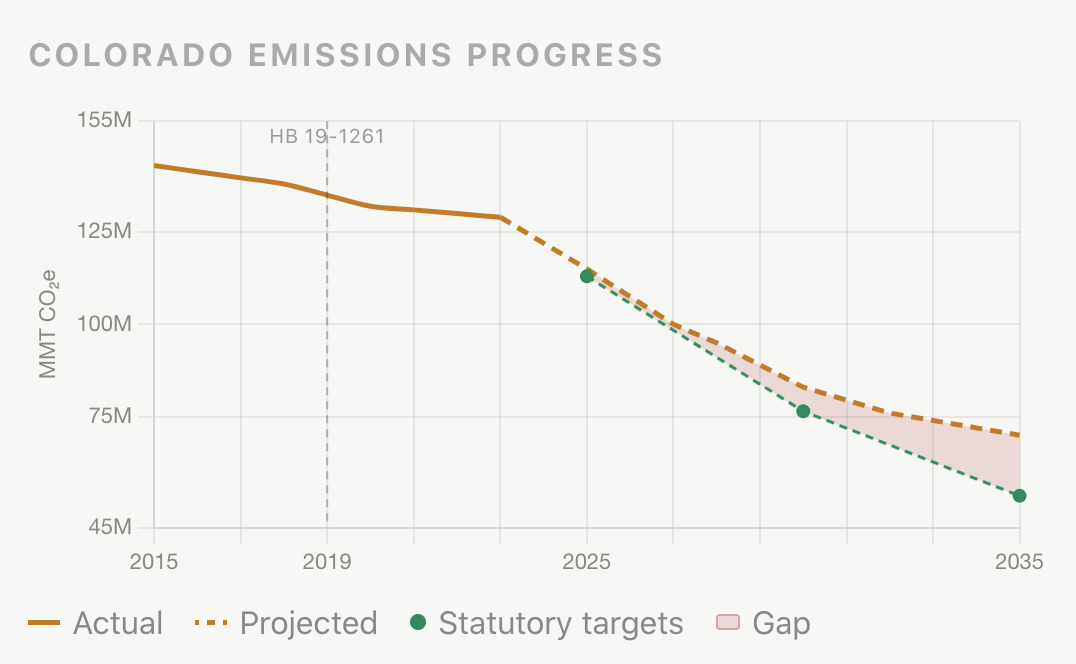
The state is currently running roughly two years behind on its goals.
The December 2025 greenhouse gas inventory put actual 2025 emissions at around 115 million metric tons against a statutory target of 109 million. That 6 million ton gap is roughly equivalent to the annual output of Xcel's two remaining coal units at Comanche Station. Colorado now expects to hit its 2025 target in 2027, with the 2030 goal tracking closer to 2031. Importantly, the state was already running about a year behind schedule before federal policy shifts occurred. Federal rollbacks didn't create this deficit, they simply widened it.
The sector by sector picture explains why closing the gap has proved so hard.
The power sector is genuinely delivering. Coal retirements have accelerated, renewables now account for around 43% of electricity generation, and the AQCC enacted tighter landfill methane rules at the end of 2025. The state has also made real progress cutting methane from oil and gas production under Regulation 7. These are real reductions, and they're the main reason Colorado's overall emissions numbers have moved at all.
Transportation tells the opposite story. Coal plant retirements have pushed electricity off the top of the emissions chart, and transportation has taken its place as the state's largest source. Its footprint is essentially flat compared to the 2005 baseline. Vehicle miles traveled bounced right back after pandemic-era dips, undercutting state projections for a 40% reduction in transportation emissions by 2030. Federal rollbacks made this harder: the $7,500 EV tax credit was eliminated, fuel efficiency standards are being rolled back, and the Trump administration rescinded NEVI charging grants that Colorado had been counting on to build out infrastructure along the Front Range and into rural communities.
Buildings and agriculture haven't moved much either. Building emissions remain stubbornly tied to natural gas heating and cooking, and while the PUC ordered investor-owned gas utilities to cut emissions 41% by 2035, more aggressively than the utilities asked for, that work is just getting started. Agricultural emissions, while a smaller portion of the overall picture, have been flat for years with no significant policy pressure to change that.
What makes this moment particularly interesting is that the emissions gap became a central issue in the Democratic primary for governor, which Weiser won over Bennet in June by 10 points. Bennet's argument was essentially that Colorado needs a fundamentally different mechanism: a cap-and-invest program that puts a declining cap on total emissions, auctions permits to polluters, and reinvests the revenue in clean energy programs and utility bill relief. It's the model Washington state and California have used, and backers like the Environmental Defense Fund have pushed for something like it in Colorado for years.
Weiser won without endorsing it. He cited concerns about TABOR, the state's taxpayer bill of rights, which makes carbon pricing programs legally complicated in Colorado, and instead focused on investing in geothermal, battery storage, and solar. He's now the presumptive next governor, which means the question of whether Colorado adopts a cap-and-invest program, or something that achieves the same effect through different means, is going to land on his desk. And in the meantime, the gap keeps widening.
Colorado can still make the adjustments it needs, but it requires the state to treat transportation emissions with the same urgency it's applied to the power sector, to use every lever of state authority it controls rather than waiting on Washington, and to have an honest conversation about whether the current suite of policies is actually calibrated to hit legally mandated targets or just to look like progress. The companies building heat pumps in Broomfield, the software platforms helping utilities manage grid demand in Boulder, the geothermal developers drilling in Weld County are part of the answer. But policy has to move at the same pace, and right now it isn't.
Written by Evan Frasz · Colorado Current